When More Images Mean Fewer Bookings: The Portfolio Trap Holding Local Talent Back

There is a particular kind of confidence that comes from a freshly printed portfolio—pages of polished studio work, dramatic lighting, a range of looks that took months and considerable expense to assemble. For many aspiring models working outside of New York, Los Angeles, or Chicago, that portfolio represents real sacrifice and genuine ambition. It also, in many cases, represents a significant strategic miscalculation.
The assumption driving most early-career portfolio decisions is straightforward: more images equal more opportunity. A thicker book demonstrates range. A wider variety of looks signals versatility. A collection of technically accomplished photographs proves seriousness of purpose. Each of these assumptions contains a grain of truth—and each, when applied without nuance, can quietly undermine a career before it gains meaningful traction.
What Casting Directors Actually See
Professional clients—whether casting directors, brand creative teams, or agency scouts reviewing new faces—spend very little time with any single portfolio. Experienced eyes move quickly, and they are trained to identify patterns rather than individual images. What they notice first is often not what the model intended to highlight.
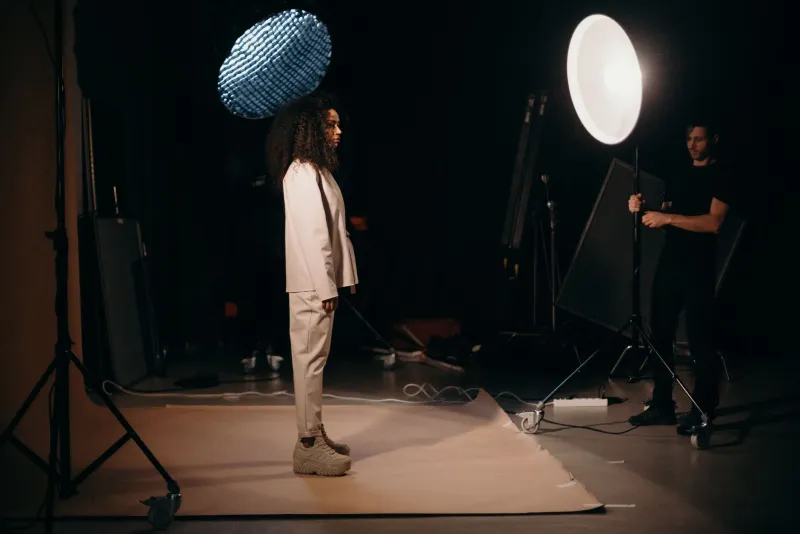
Local studio work carries recognizable visual characteristics. The lighting setups favored by regional photographers tend to follow predictable conventions. Backdrop choices, retouching styles, and posing directions common in smaller markets frequently differ from the aesthetic language used in editorial and commercial production at the national level. None of this reflects poorly on the photographers themselves—talented professionals work in every market—but the visual vocabulary of a portfolio built exclusively within a single local ecosystem often reads as exactly that to someone accustomed to reviewing work produced across multiple markets and production contexts.
Beyond aesthetics, the nature of the work itself communicates something important. A portfolio composed entirely of test shoots and studio sessions—however beautiful—contains no evidence of actual professional engagement. It demonstrates that a photographer found someone worth photographing. It does not demonstrate that a client found someone worth hiring.
The Volume Problem
One of the more counterintuitive realities of professional portfolio development is that a carefully curated selection of eight to twelve images will almost always outperform a comprehensive collection of thirty or forty. This runs contrary to the instinct that drives most early investment decisions, but it reflects how professional review actually functions.
A bloated portfolio forces the viewer to do editorial work the model should have done in advance. Every weak image dilutes the impact of the strong ones. Every shot that reads as filler—included because it fills a gap or represents a look not otherwise covered—signals that the talent or their representation lacks the discernment to distinguish between what is adequate and what is genuinely compelling. In a professional context, that discernment is itself a form of credibility.
Editing ruthlessly is not an act of self-limitation. It is an act of professional confidence. The model who presents ten images, each of which demonstrates something specific and valuable, is communicating a more sophisticated understanding of the industry than the model who presents forty images hoping the volume itself conveys commitment.
Identifying Work That Travels
Not all local work lacks currency in major markets. The relevant question is not where an image was produced but whether it reflects the visual and conceptual standards of the market the model is targeting.
Some local photographers have built genuine relationships with national publications, regional advertising clients, or emerging brands with real production budgets. Work produced in those contexts carries the same professional weight as work produced in larger cities, because it emerged from an actual client relationship with real creative direction and genuine commercial stakes. That distinction—between work produced for a client and work produced to fill a portfolio—is legible to professional reviewers even when they cannot identify the specific photographer or project.
Models evaluating potential collaborators in their home market should ask direct questions about the photographer's client history, not just their technical capabilities or aesthetic sensibility. A photographer who regularly shoots for regional retail brands, local advertising agencies, or editorial clients—even at a modest scale—is producing work in a fundamentally different context than one whose portfolio consists primarily of personal projects and model collaborations. Both may produce beautiful images. Only one is producing images that communicate professional experience.
The Strategic Case for Fewer, Better Images
The most effective portfolio strategy for talent working outside major markets often involves a deliberate combination of selective local work and targeted investment in production contexts that carry broader market recognition. This might mean traveling for a single well-chosen test shoot with a photographer whose work circulates in the markets the model is pursuing. It might mean prioritizing one legitimate editorial opportunity over three studio sessions. It might mean leaving a gap in the portfolio rather than filling it with work that weakens the overall impression.
This approach requires a level of patience that conflicts with the urgency most aspiring models feel, particularly early in their careers. The pressure to have something to show—to demonstrate progress, to justify the investment of time and resources—is real and understandable. But the portfolio is not a record of effort. It is a professional argument. And a focused, well-constructed argument, even a brief one, is more persuasive than a lengthy one that undermines its own strongest points.
Reframing What the Portfolio Is For
At its core, a professional portfolio serves a single purpose: to give a client sufficient reason to take the next step. That next step might be a casting call, a direct booking inquiry, or a conversation with representation. The portfolio does not need to answer every possible question about a model's range or capabilities. It needs to create enough interest and confidence to prompt a response.
Models who understand this reframe their entire approach to portfolio development. Rather than asking what gaps need to be filled, they ask what impression needs to be created. Rather than adding images to cover more ground, they remove images that complicate or dilute the central impression. Rather than treating the portfolio as a comprehensive record, they treat it as a carefully constructed introduction.
That shift in perspective—from documentation to argument, from volume to precision—is one of the clearest markers separating talent that is building toward something real from talent that is investing heavily in the appearance of progress. In a competitive industry where professional clients review dozens of portfolios before making a single decision, the difference between those two orientations is rarely subtle, and it is almost never forgiven.
Building a career from outside a major market is genuinely possible. Talent, preparation, and strategic clarity matter far more than geography. But that clarity has to extend to the portfolio itself—to the willingness to show less, choose better, and trust that precision, not volume, is what earns a seat at the table.