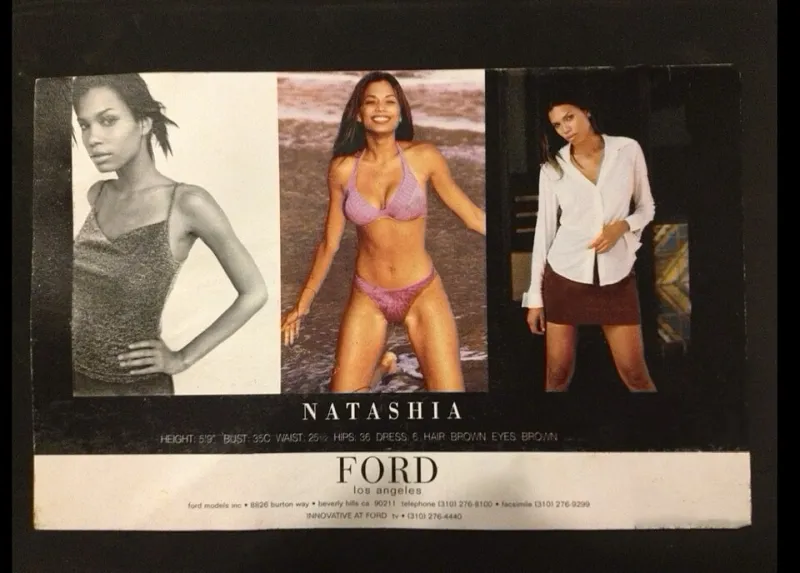
What Your Comp Card Is Costing You: The Hidden Disconnect Between Beautiful Photos and Actual Bookings

Photo: ModelArchives, CC0, via Wikimedia Commons
There is a quiet crisis unfolding inside the portfolios of talented models across the country. It does not announce itself. It does not show up in rejection emails or feedback calls. It lives, instead, on a single laminated card — the comp card — and it is costing models bookings they never knew they lost.
The comp card, for all its apparent simplicity, is one of the most consequential documents in a working model's career. In the seconds a casting director glances at it before moving to the next submission, that card either opens a door or closes one. Yet an increasing number of industry professionals are raising a concern that rarely surfaces in open conversation: models are curating these cards for the wrong audience entirely.
The Mirror Problem
Human psychology is not neutral when it comes to self-presentation. Research in behavioral decision-making consistently shows that individuals gravitate toward images of themselves that align with their idealized self-concept — not necessarily the version of themselves that performs best in a commercial context. For models, this tendency manifests in a predictable pattern: selecting photographs that feel emotionally resonant, artistically ambitious, or personally flattering, while unconsciously sidelining images that might read as more accessible, versatile, or commercially viable.
"I can tell within the first five seconds whether a model built their card for themselves or for me," says one New York-based casting director who has worked across editorial, commercial, and catalog markets for over a decade. "The ones built for themselves are usually stunning. They're also usually the ones I put down without making a call."
The distinction she draws is not about quality. It is about utility. A comp card designed to showcase personal aesthetic vision serves a different function than one engineered to answer the casting director's unspoken question: Can this person do what my client needs?
What Clients Actually Hire For
Understanding this gap requires stepping back from the world of editorial aspiration and into the more pragmatic reality of how most modeling bookings are actually generated in the United States market.
The majority of paid work — catalog shoots, e-commerce campaigns, regional advertising, health and wellness brands, lifestyle imagery — demands a quality that is far less glamorous than high fashion: legibility. Clients in these categories need to look at a comp card and immediately understand what they're getting. Approachability. Range. Consistency of expression. A face or figure that does not distract from the product being sold.
When a model's card leads with a dramatic editorial image — heavy shadow, unconventional styling, an expression calibrated for a magazine spread — it may communicate artistry. What it often fails to communicate is adaptability. And adaptability, in commercial markets, is currency.
"We're not hiring the photo," explains a talent buyer who works with mid-size retail brands on seasonal campaigns. "We're hiring the person we believe can show up and execute across twelve setups in a single day. If your card only shows me one version of you, I'm already uncertain."
The Vanity Metric Trap
The problem is compounded by the feedback loops models rely on to evaluate their own materials. Compliments from friends, engagement on social media, approval from photographers — these signals reinforce the selection of images that generate emotional responses, not necessarily the images that generate bookings.
This creates what might be called the vanity metric trap: a cycle in which models optimize their comp cards for applause rather than conversion, then interpret a lack of bookings as a problem with their look rather than their presentation strategy.
Several agents interviewed for this piece noted that one of the most common conversations they have with new talent involves gently redirecting models away from their favorite images and toward the images that actually move the needle with clients.
"A model will come in absolutely certain about which photos should lead their card," one Chicago-based agent recalled. "Nine times out of ten, the image they're least excited about is the one that books the job."
A Framework for Objective Self-Assessment
Breaking the cycle requires a deliberate shift in perspective — one that treats the comp card not as a personal portfolio but as a sales tool with a specific audience and a measurable objective.
The following framework offers a starting point for models and their representatives:
Identify the target client first. Before selecting a single image, define the category of work you are actively pursuing. Commercial lifestyle? Fitness? Beauty? Catalog? Each segment has distinct visual expectations. Your card should speak directly to those expectations, not to a generalized notion of what "good modeling" looks like.
Remove yourself from the selection process. Ask your agent, a trusted colleague with industry experience, or a casting professional to select images without your input. The difference between their selections and yours will reveal your blind spots more clearly than any amount of self-reflection.
Apply the five-second test. Hand your current comp card to someone unfamiliar with your work and give them five seconds to look at it. Ask them to describe what kind of model they think you are and what types of jobs they imagine you booking. If their answer does not match your target market, your card is not doing its job.
Prioritize range over drama. Unless you are specifically pursuing high fashion or avant-garde editorial work, a comp card that demonstrates versatility — multiple expressions, clean commercial looks alongside personality-driven images — will consistently outperform one that prioritizes a single, striking aesthetic.
Revisit the card quarterly. Markets shift. Client preferences evolve. A comp card that performed well eighteen months ago may no longer reflect what buyers in your category are seeking. Treat it as a living document, not a finished product.
The Harder Conversation
Perhaps the most challenging aspect of this issue is the emotional weight models attach to their images. Modeling, by its nature, requires extraordinary vulnerability. The photographs on a comp card are not just marketing materials — they are, in a very real sense, a representation of self. Asking a model to set aside their favorite images in favor of more strategically useful ones can feel like a request to diminish their identity.
But the most successful working models understand a distinction that takes time to internalize: the comp card is not a statement of who you are. It is an invitation for a client to imagine what you can do for them. That is a fundamentally different document, and it deserves to be built with fundamentally different criteria.
At FunCity Model, we work with talent at every stage of their careers, and the conversation about comp card strategy is one of the earliest and most important we have. The models who approach it with objectivity — who are willing to prioritize the client's perspective over their own — are consistently the ones who build the kind of booking history that sustains a long career.
Beauty gets you noticed. Strategy gets you hired. Your comp card should know the difference.